
Hamburg Township Previous Residents by Era
Previous residents of a Hamburg Township address are best traced as a stack of time-stamped evidence. The present parcel and its legal description lead to recorded instruments. Historical maps, directories, and censuses then help test who was associated with that location at a particular time. A source can support an owner, recorded party, household, or place clue. It cannot fill gaps left by a missing index or an address that did not yet exist.
| Source | Years It Covers | Where Held | What It Shows |
|---|---|---|---|
| Register of Deeds online index and images | Generally from November 7, 1980 or Liber 1000 | Livingston County Register of Deeds | Recorded parties, instrument data, legal description, and images where available. |
| Grantor, grantee, and tract indexes | Recorded documents begin about 1836-37 | Register of Deeds office | Earlier recorded party trail and legal-description bridge. |
| Combined county atlases | 1875, 1895, 1915 | FamilySearch and Library of Congress | Landowner and road clues, not conclusive title. |
| Livingston and Howell directories | 1873-74 and July 1915 leads | Genealogy collections and Library of Michigan | Named household or business/mailing clues with limited geography. |
| Hamburg census entries | 1850, 1860, 1870, 1880 | Livingston County genealogy pathway | Households, ages, and neighboring families; no 1890 shortcut. |
| Howell Archives holdings | Dates vary by collection | Appointment-only archive | Abstracts, maps, township records, directories, newspapers, and obituaries. |
For recent transfers, begin with the county parcel record and the Register of Deeds. For a nineteenth-century question, move quickly to the legal description, tract indexes, atlases, and repository material. The difference matters because a modern street number may not appear in an early instrument.
Start Hamburg Township Previous Residents with Land
Begin with Livingston County Property Search, using the street number and name or a parcel number. The portal accepts owner, parcel, address, street range, and local-unit searches, but its record is a current-property lead. A PIN, or Parcel Identification Number, and the legal description should be copied into the research notes before a name is searched backward. The legal description is the more durable identifier when a road, route, or later assigned number changes.
The county property page joins Treasurer and Equalization data. It limits a number range to 1,000 and a result set to 50, so smaller blocks may be needed. Follow the result into the Livingston GIS Parcel Viewer to compare the parcel shape, road, property address, acreage, and property-summary link. Neither display is a title opinion or proof that an owner occupied the address.
A current property card is the first page of the backward trail, not its conclusion. Record the source date and retain any mismatch between mailing address, situs address, and postal city. That context helps prevent an old party name from being attached to the wrong modern address.
Hamburg Township Previous Residents and Liber Gaps
The Livingston County Register of Deeds FAQ draws an important line between an online image and a computer-searchable name. Documents recorded since November 7, 1980, or Liber 1000, are generally indexed and imaged online. Libers 27-37 were indexed for part of the 1856-1866 period. Libers 1-26 and 192-1004 may have images but generally lack a computer index, while Libers 38-191 are hard-copy only.
That uneven coverage is normal for old address work. Use the office’s grantor/grantee and tract indexes when the online search stops. The Register of Deeds says recorded-document indexes reach back to the beginning of county recordings around 1836-37. For an online gap, the documented routes are public self-service computers, tract-index books, a quick phone or in-person search, a mailed copy request, or a paid report request. Staff provide access and copies but do not prepare a title abstract.
For an estate transfer, Livingston Probate can provide a separate lead by decedent or case number. Probate records before 2004 may require a phone inquiry, and closed or stored files can require advance contact. Connect a probate file to the parcel through a legal description or recorded sale material, not merely a matching surname.
Trace Hamburg Township Previous Residents by Deed
Deeds trace recorded property parties, which makes them a crucial but limited route to previous residents. A present owner may be a trust, estate, corporation, or nonresident. A grantee may not have moved in. Use the document’s legal description, instrument date, recording date, Liber and page or instrument number, and document type to decide whether two records concern the same land.
- Capture the current PIN, legal description, and property address from the county property and GIS records.
- Search the present recorded party as grantee in the deed index and open the purchase instrument when the legal description matches.
- Record the seller as grantor, then search that party as a prior grantee, again matching the land description rather than name alone.
- Repeat through each matched instrument, noting a probate, trust, corporate, or legal-description change as its own research branch.
- When the online sequence reaches an index gap, take the PIN and legal description to the hard-copy grantor/grantee and tract-index route.
- Grantor / grantee
- The grantor transfers an interest in a recorded instrument. The grantee receives that recorded interest.
- Chain of title
- A sequence of recorded instruments linked by the same land description. It is not a county-certified ownership determination.
- Legal description
- The section, lot, subdivision, metes-and-bounds, or other land description used in the instrument. It often bridges records that predate street numbers.
- Tract index
- An index organized by land description rather than person name, useful when names vary or an old address is absent.
Hamburg Township Previous Residents in Atlas Clues
Atlases place a property in its historical road and section setting. The combined 1875, 1895, and 1915 Livingston County atlas is a useful landowner and road clue. Pair it with a current GIS parcel and a recorded legal description. A name printed on an atlas page is time-stamped historical evidence, not proof of title or residence on every date.
The atlas can reveal a road alignment, nearby owner, or section reference that helps identify the correct parcel before the modern street address existed. The Library of Congress 1895 Standard Atlas catalog is another direct source for that era. Keep any inferred bridge labeled as such until a deed, abstract, or other direct source confirms it.
Hamburg Township Previous Residents at Howell Archives
Howell Carnegie District Library Archives is appointment-only and holds original property abstracts, township records, plat maps, city and telephone directories, cemetery records, newspapers, and microfilm. It is the local fallback when a dated record is not online. Contact the archive before assuming a particular Hamburg file is available, because catalog results and offline holdings are not the same thing.
The following image is from Howell Carnegie District Library Archives, a source for house-history materials rather than a list of current people.
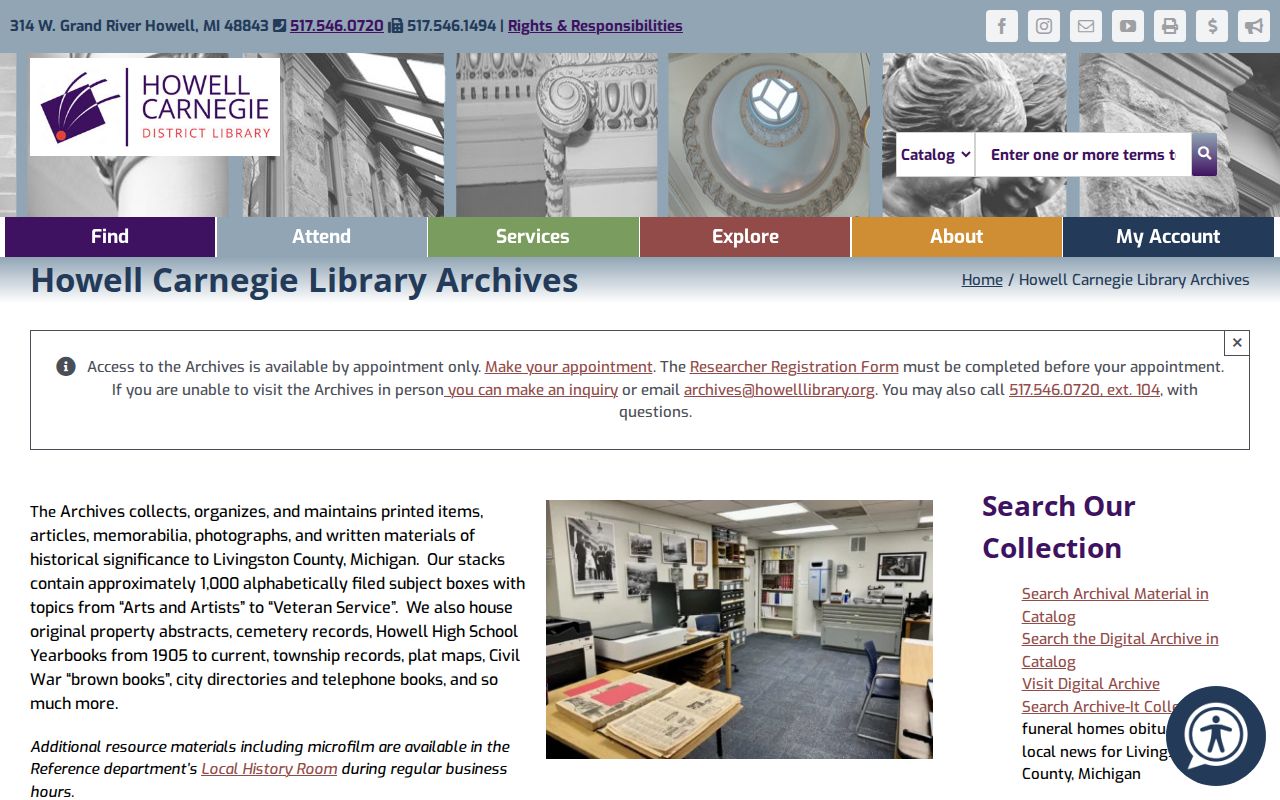
Its abstracts, maps, directories, and newspaper microfilm can supply the dated context needed to test a deed trail. A source citation should preserve the collection name, page or file reference, date, and the specific relationship it supports.
Hamburg Township Previous Residents Household Tests
Property parties are only one layer of an address history. The verified Livingston County Directory for 1873-74 and Howell City Directory for July 1915 are dated leads, but neither is a complete Hamburg Township household list. The Howell volume can reflect a business, mailing, or later-move connection. Use the source’s own area label and do not convert a directory name into a firm residence claim.
The historical collections themselves are described on the Hamburg Township city directories page. For an address trail, pair each year with a second source and preserve the test result.
- Find the road, township, section, or surname in a dated directory, atlas, or newspaper index.
- Compare the date with Hamburg entries in the 1850, 1860, 1870, or 1880 census pathways, using ages and adjacent families as checks.
- Do not fill the 1890 gap with an invented household. The federal 1890 census is generally unavailable.
- Test a promising name against the legal description, recorded deed, abstract, obituary, or probate record.
- Mark the result as direct entry, official index pointer, catalog lead, inferred parcel bridge, or unresolved.
Obituaries and cemetery material can offer an end point for a household trail, but they still need source and date checks. The Howell digital archive holds obituary, death-notice, scrapbook, and funeral-card material for Livingston County. A published address is a clue, not automatic proof that the person lived at the exact parcel.
Lawful use. Hamburg Township previous-resident research is for house history, family history, estate questions, and personal curiosity. Do not use dated address material to track, harass, or harm a living person.
Hamburg Township Previous Residents Research Stops
A useful house history names its gaps. No Hamburg-specific Sanborn Fire Insurance map run was verified in the research, and Sanborn maps often favor incorporated and built-up places. Check the Library of Congress, Library of Michigan, Howell Archives, and local map holdings before claiming coverage. The Michigan Archives guide lists general Livingston assessment rolls for 1837-1880, yet no Hamburg-specific assessment series was located in that guide.
A deed chain may stop at a pre-index Liber, unrecorded instrument, probate event, private transaction, or legal-description mismatch. State the last direct source, the missing link, and the next repository. That is more reliable than guessing who lived here before.
Note: Keep direct record images, catalog leads, and inferred address bridges separate so future research can confirm or correct each layer.